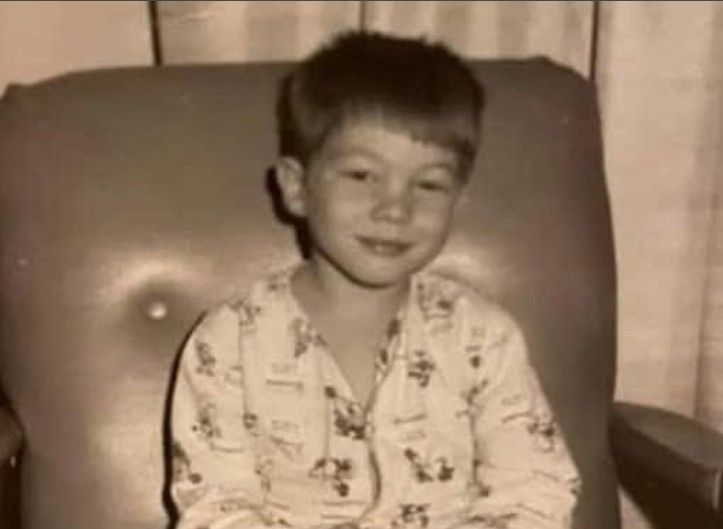
He grew up in a small American town where fear ruled the house and joy felt like a forbidden luxury. From the outside, everything looked orderly and deeply religious, but behind closed doors it was a world of strict rules, silence, and emotional pressure. Music, television, even simple childhood pleasures were branded as sinful. For a sensitive, restless child, this environment felt less like a home and more like a cage.
From an early age, he sensed that something about his family story didn’t add up. The man he believed to be his father was distant and harsh, while his mother seemed emotionally absent, unable — or unwilling — to protect him. Church was not a refuge but an extension of control, attended several times a week. Years later, he would describe that period with chilling simplicity: everything was evil. Fear shaped his thinking long before fame ever could.
School offered no escape. Instead of understanding, he found ridicule. Instead of support, underestimation. Teachers and classmates saw a troubled kid; he saw something else entirely — a future no one around him could imagine. Even while being bullied and misunderstood, he carried a quiet, stubborn conviction. He told friends he would make it out. Somehow. Somewhere.
That child was Axl Rose, born William Bruce Rose Jr. on February 6, 1962, in Lafayette, Indiana — the future frontman of Guns N’ Roses. Raised by a teenage mother and believing his stepfather was his biological parent, Axl only later learned the truth about his real father, who would be murdered years afterward. The revelation added yet another layer to a childhood already marked by confusion and trauma.

As a teenager, the pain began to surface in destructive ways. He clashed with authority, rebelled openly, and found himself repeatedly in trouble with the law. Later diagnosed with bipolar disorder, many of his emotional extremes finally made sense. Facing the possibility of serious charges, he made a life-changing decision: leave Indiana behind. Running wasn’t cowardice — it was survival.
Music had always been his lifeline. He sang in church choirs as a child, studied piano, and performed whenever he could. Teachers remembered his voice and charisma long before the world did. In 1982, at just 20 years old, he arrived in Los Angeles with nothing but ambition and raw talent. It was there he took the name Axl Rose — a reinvention, and a break from the past.
By 1985, Guns N’ Roses was born. Two years later, Appetite for Destruction exploded onto the scene. After relentless touring and the unexpected success of “Sweet Child o’ Mine,” the album climbed to No. 1 and eventually became the best-selling debut album in U.S. history. The boy from Indiana had become the voice of a generation.
Fame, however, didn’t heal old wounds. His perfectionism, intensity, and volatile temper fueled infamous moments, including riots and public breakdowns. Axl himself admitted that much of his chaos came from unresolved childhood trauma — damage done long before the spotlight. Relationships suffered, marriages collapsed, but the music endured, turning pain into anthems.
In 2012, Guns N’ Roses were inducted into the Rock and Roll Hall of Fame. True to form, Axl declined to attend. Years later, he returned to the stage, his voice still unmistakable, his presence still commanding.
Many believe his legend was forged long before the fame — in a childhood filled with fear, silence, and unanswered pain. It wasn’t success that made him who he is. It was survival.