


Only then did authorities clarify where the quake had originated. The earthquake struck off the coast of Oregon, with shaking reported across several cities, including Portland, Eugene, Salem, Coos Bay, and Dallas. Some residents described light swaying, while others reported sharp but brief shaking, even hundreds of miles from the epicenter.
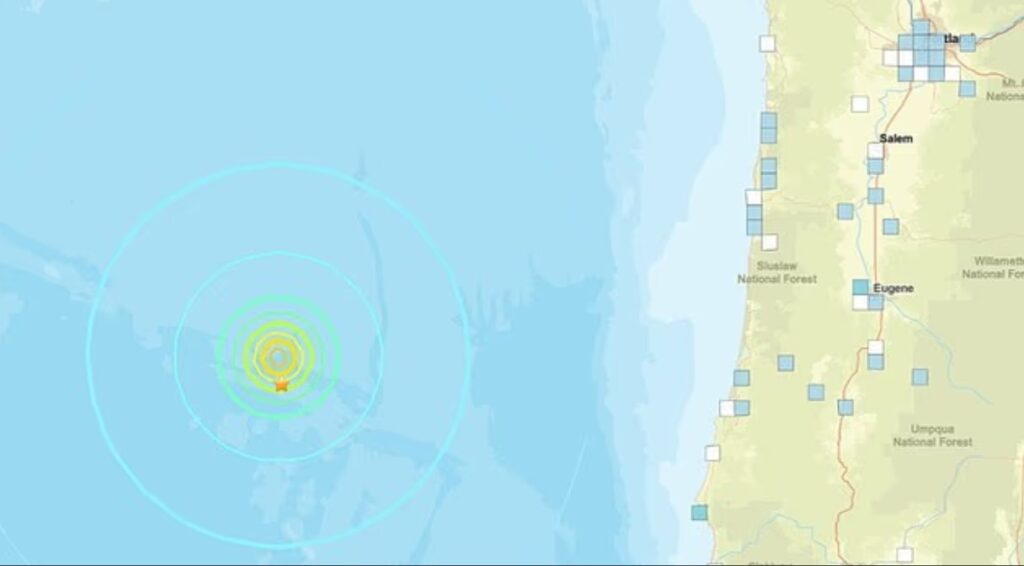
The quake occurred along the Juan de Fuca Plate, part of the notorious Cascadia Subduction Zone — a massive fault system stretching nearly 700 miles along the Pacific coast. Scientists have long referred to it as a “sleeping giant,” capable of unleashing a far more devastating earthquake than the one just recorded.
While officials confirmed that no tsunami threat materialized and no dangerous waves reached the coastline, experts caution that this event is a reminder of what the region is capable of. Studies suggest the fault could eventually produce a magnitude 8.0–9.0 earthquake, a scenario that would impact major population centers and dramatically reshape the coastline.
For now, the risk of a catastrophic rupture remains low, but not zero. Seismologists emphasize that offshore earthquakes like this one are warnings written into the planet’s geology — brief, unsettling signals that the ground beneath the Pacific Northwest is never truly at rest.