

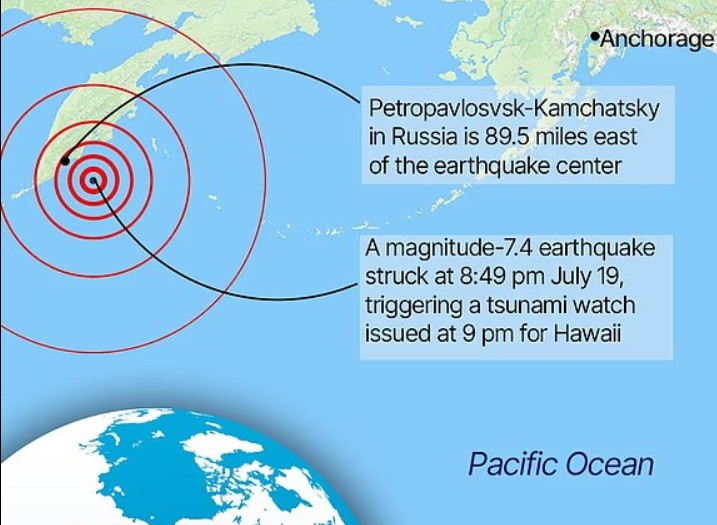
The 7.5 magnitude quake struck at 8:49 PM local time. It was triggered by a seismic event off the coast of Kamchatka, in far eastern Russia. The shared waters of the Pacific Ocean made Hawaii vulnerable to potential aftershocks — or worse, tsunami waves.
At 9:03 PM, a tsunami watch was officially announced. However, not long after, the Pacific Tsunami Warning Center canceled the alert, stating there was no danger to the islands. “Based on all available data, there is no tsunami threat to the state of Hawai‘i,” the agency declared.
Still, anxiety lingered among locals. Some took to social media with relief: “Watch has been canceled. Relax. Enjoy your Mai Tai,” one woman wrote in a local Facebook group. Others thanked God, expressing their joy and gratitude.
Earlier that same day, a powerful series of earthquakes had shaken Kamchatka. The largest registered 7.3 and 7.4 in magnitude, followed by several more minor tremors. Russian authorities warned residents to stay away from the coast and not attempt to observe the waves.
This isn’t the first time seismic activity in Kamchatka has threatened distant regions. In 1952, a devastating magnitude 9 quake caused a Pacific-wide tsunami that reached Hawaii, destroying infrastructure, bridges, and damaging piers and boats.
Although the tsunami warning was officially lifted, locals remain cautious. “Even if there’s no wave, the surge is still real. I’ve seen people get pulled out to sea before,” warned one resident. “Don’t be reckless. Stay alert.”