


It was only then confirmed: a powerful 7.4-magnitude earthquake had struck off the northeastern coast of Japan, triggering an immediate tsunami warning. Officials urged residents near coastal and riverside areas to evacuate without delay and move to higher ground.
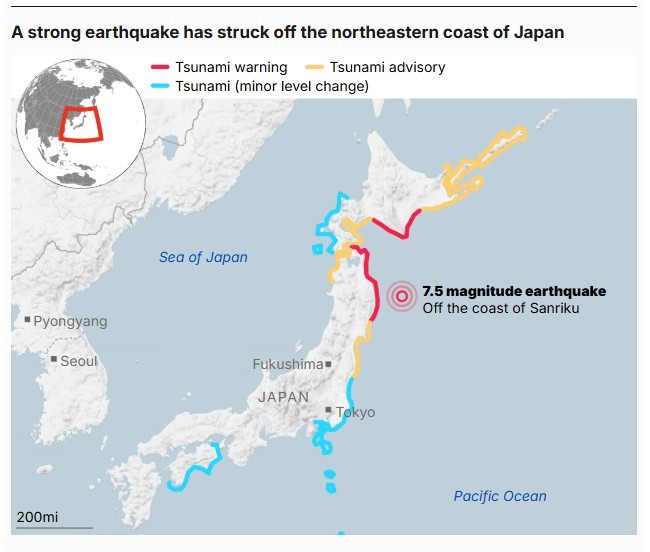
Experts warned that waves as high as three meters could reach shorelines shortly after the quake. Initial surges had already been recorded, including waves measuring up to 80 centimeters at northern ports. Though smaller waves were expected in some regions, the threat remained serious due to the possibility of repeated impacts.
The epicenter of the earthquake was located in the Pacific Ocean at a relatively shallow depth, intensifying its effects. Buildings hundreds of miles away swayed, including in Tokyo, while dramatic footage showed the force of the tremor inside homes and public spaces.
Emergency services were mobilized immediately. Military units were dispatched to assist vulnerable areas, while transportation systems, including high-speed trains, were halted as a precaution. Authorities also confirmed that no abnormalities had been detected at nearby nuclear facilities.
Despite the fear, officials emphasized the importance of staying calm but vigilant. “Do not return to coastal areas until the warning is officially lifted,” they urged, noting that tsunami waves can arrive in multiple surges over time.
Japan, situated along the volatile Pacific “Ring of Fire,” is no stranger to such events. However, the memory of past disasters lingers — a reminder of how quickly nature can escalate from a tremor to a full-scale crisis.