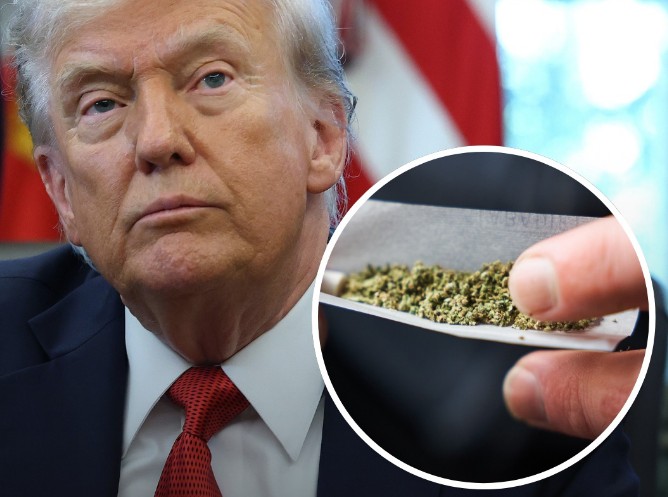
President Donald Trump has decided to reclassify marijuana as less dangerous in the US.
The US Department of Justice has announced the decision to classify cannabis as less dangerous, marking a big step in legalising the drug and a significant change in the nation’s drug policy.
Acting Attorney General Todd Blanche confirmed that the classifications of products containing marijuana that are covered by the Food and Drug Administration (FDA), or that have received a state medical-marijuana licence, have changed for good.
Once considered a Schedule I narcotic, such as the likes of heroin, marijuana is now considered a Schedule III drug, on par with Tylenol with Codeine.
Trump had instructed his administration to work to start the reclassification process, so access would be easier and further research into the drug could be carried out.
However, marijuana still remains illegal at the federal level, though most US stated have legalised the medical or recreational use of marijuana.
Several states also have shops where you can legally purchase the drug.
Products containing cannabis now considered Schedule III
Schedule III drugs are known as controlled substances, which have a moderate to low potential for physical and psychological dependence, lower than Schedule I and II.
Blanche stated on Thursday (23 April): “The Department of Justice is delivering on President Trump’s promise to expand Americans’ access to medical treatment options,
“This rescheduling action allows for research on the safety and efficacy of this substance, ultimately providing patients with better care and doctors with more reliable information.”
He additionally called a hearing to consider reclassifying all marijuana.
Blanche has scheduled the hearing for June, as part of a rule-making process, with the goal of reclassifying all marijuana across the US.
When the rule change is published in the Federal Register, it has 30 days before taking effect – though in this time, it can be legally challenged and potentially be blocked from being implemented for months or years.
Blanche’s order was announced just five days after Trump approved and signed an executive order to increase access to psychedelic drugs for medical treatment.
Aiming for the full legalisation of marijuana
Ever since 1970, the US has classified marijuana as a Schedule I controlled substance, which means it has a “high potential for abuse” and at the time, there was “no currently accepted medical use”.
In the last 56 years, states have taken action to have their own laws which includes lesser restrictions on marijuana.
States such as California were the first to allow the substance to be used for medical purposes, which brought on a new wave of regulations and enforcement on the drug.
Back in 2022, Joe Biden’s administration began a review of marijuana’s classification, with the US health department recommending a change for the first time just one year later.
In 2024, the Drug Enforcement Administration (DEA) requested hearings, though these would be postponed.
Morgan Fox of he National Organization for the Reform of Marijuana Laws (Norml), said that the President’s latest move is mostly “symbolic.”
Fox claimed that two-thirds of Americans support the full legalisation of cannabis, who claimed that changing its classification may result in policymakers lifting restrictions on the substance.
He explained: “Moving it out of that classification allows us to have policy conversations that don’t start and end with that definition,”
“Lots of policymakers continue to fall back on that, and really won’t even discuss the issue as long as cannabis is Schedule I.”
“The real solution to the issue is to de-schedule cannabis at the federal level, not just move to Schedule III, and then start changing the laws in regulatory ways that provide guidance, so we can get a little bit of uniformity,” he claimed, as his group and other campaigners will keep fighting for full federal legalisation.