

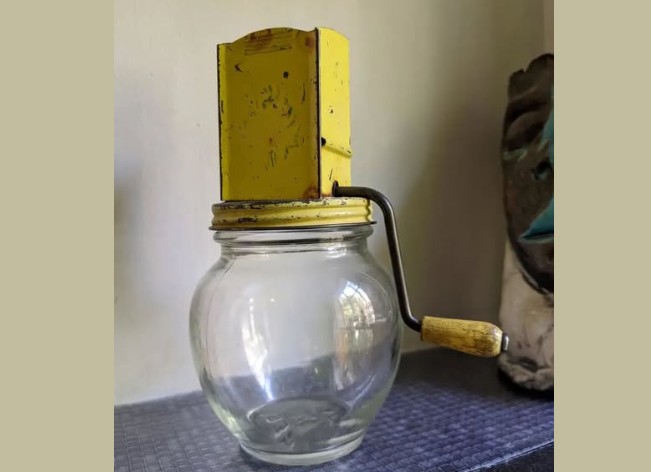
The answer turned out to be surprisingly simple: it’s an old-fashioned nut grinder, a common kitchen tool from the days before electric food processors and powerful blenders became everyday appliances.
The grinder was designed to chop nuts and other relatively firm ingredients into small pieces. Instead of plugging it into an outlet, you simply turned the handle by hand. Inside, a grinding mechanism crushed or chopped the food while the finished pieces dropped into a container below.
Many versions were designed to sit directly on top of a glass jar or small container. That explains the unusual shape: the upper section held the grinding mechanism, while the jar underneath collected everything neatly. From a distance, the little crank could make the whole thing look more like a miniature music box than a kitchen utensil.
Today, the same job takes only seconds. We reach for a blender, food processor, electric grinder, or sometimes even a meat grinder when dealing with tougher ingredients. But kitchens of the past relied heavily on simple mechanical tools like this one.
What makes these old grinders interesting is how practical their design was. They needed no electricity, took up little space, and could be used whenever necessary. A few turns of the handle transformed whole nuts into pieces suitable for cakes, cookies, fillings, toppings, and other homemade dishes.
And that may explain why so many of these objects survive in grandparents’ kitchens. They were built for one specific task, but they did that task well enough to remain useful for years.
So if you ever discover a strange hand-cranked gadget sitting in an old kitchen cabinet, don’t be too quick to dismiss it as a random piece of metal. What looks mysterious today may once have been an ordinary kitchen essential.
Sometimes the most confusing objects from the past are simply the ancestors of appliances we use without thinking twice today.