

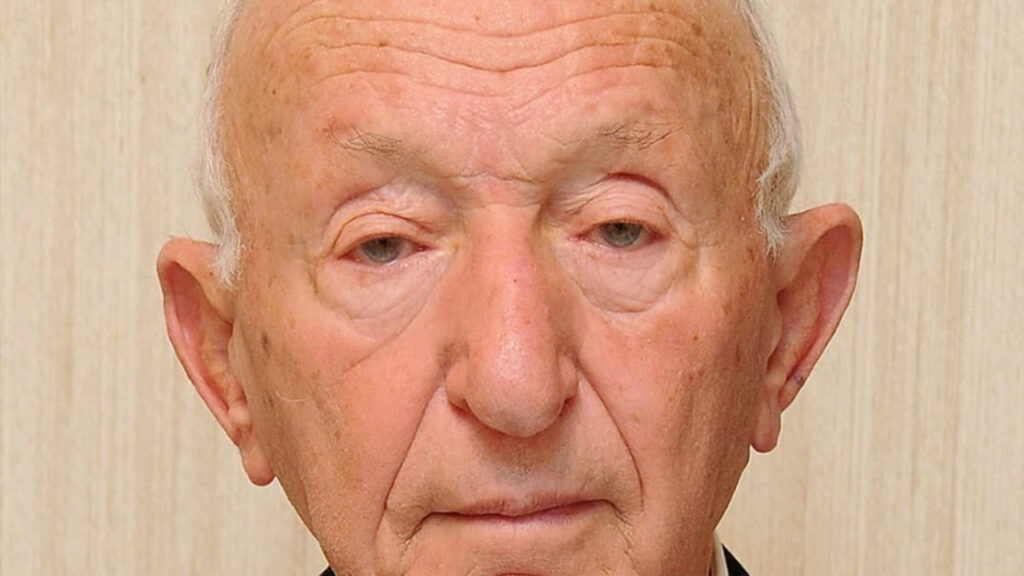
The man was Yehuda Aharon Widawski, one of Israel’s oldest Holocaust survivors, who died at 107. Born in 1919 in Turek, Poland, his life became a story of survival and remembrance.
After Nazi Germany occupied Poland, Widawski and his family were forced into the Łódź Ghetto. In August 1944, they were deported to Auschwitz-Birkenau. His parents and several siblings were murdered; only Yehuda and his brother Yehoshua survived.
They were later sent to a forced-labor camp near Breslau, where prisoners assembled aircraft wings. Widawski endured hunger, exhausting marches, and fear until Soviet forces liberated the camp in May 1945.
After the war, he returned to Łódź, married Dobrish Wassercug, and rebuilt his life. In 1950, the family immigrated to Israel and settled in Tel Aviv, where they raised their children.
In 1978, Widawski returned to Poland searching for his grandmother’s grave. Seeing Jewish cemeteries neglected transformed a personal journey into a lifelong mission to preserve the communities the Nazis had tried to erase.
Using historical records, he helped identify and restore more than 3,000 Jewish graves and preserve cemeteries across Poland. In 2012, Yad Vashem chose him to light a torch at Israel’s Holocaust Remembrance Day ceremony.
Asked what his answer to the Nazis was, Widawski pointed not to hatred, but to survival: they had lost, while Jewish life continued. He lived to see a fifth generation of descendants.
Yehuda Aharon Widawski is gone, but the names he helped recover, the graves he restored, and the family he rebuilt remain. His life shows that even after unimaginable loss, memory can endure — and life can answer darkness.