

Other common hot-spots include the lips, neck, ears, abdomen and feet, and for women, the nipples and inner thighs also serve as prime locations for the tingles down below.
Recent statistics have shown that provocation of the prostate gland has been associated with deep sexual pleasure – so much so that some sexperts have dubbed this region the male G-spot.
But a new study has hugely contradicted this verdict, suggesting that the real G-spot is several centimetres north, in a largely overlooked area of the penis.
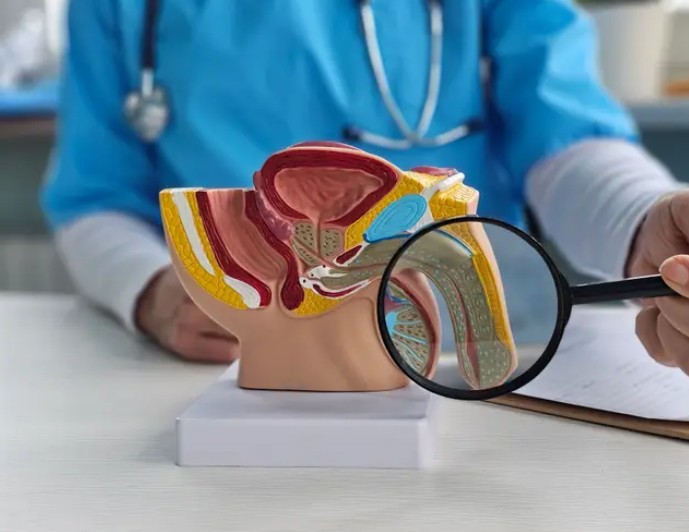
As documented in the latest issue of the scientific journal, Andology, a research team studied samples of penile tissue taken from 30 foetuses and 14 adult males who’d donated their bodies to science postmortem.
Any gents reading this, look away now – to study sensation in the penis, they sliced the donated genitals into small sections, just a few millimetres thick, and then added a dye which bound to nerve endings.
They found plenty of nerve endings in the glans, the head of the penis, but the real ‘on-switch’ is thought to be in the frenula delta, the triangular area at the underside of the penis, where the head meets the shaft.
This region of the phallus has long been considered something of a biological mystery, to the extent that it’s often left out of sexual health textbooks (via New Scientist).
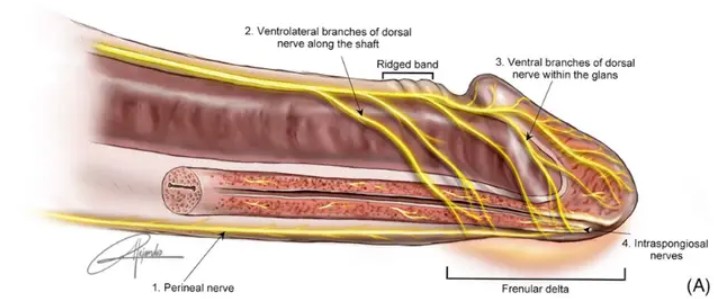
Despite this, scientists at the University of Santiago de Compostela in Spain described the frenula delta as being ‘richly innervated by partially overlapping perineal (related to the region connecting genitals and anus) and dorsal (aft-facing) nerve branches’.
They also discuss this area having ‘heightened concentrations of nerve bundles’, which serve as pleasure receptors. In fact, they were clustered in groups of up to 17.
“Although this may seem self-evident to anyone attuned to the sensations of their penis during sexual activity, our work scientifically validates the existence of a ventral penile anatomical region that serves as a centre of sexual sensation,” one of the authors, Alfonso Cepeda-Emiliani, wrote.
There’s one big problem with the male G-spot being located here
Unfortunately, this region is often damaged during circumcision, which is the surgical removal of the foreskin, often for religious reasons.
According to IFL Science, one particularly common method of circumcision cuts right through the frenulum, which could reduce pleasurable sensations for some men if the incision is too deep.
And the trouble is, most doctors don’t know about the frenula delta.
New Scientist spoke to Kesley Pedler at Port Macquarie Base Hospital in Australia, who said the frenula delta wasn’t mentioned in any of her medical textbooks.
She said: “Now we know about this area of nerves, it’s even more important to only do these operations when they’re absolutely indicated.”
Of course, many people would likely disagree with Pedler, with circumcision being an important part of some religions and cultures, but it’s definitely something for medics to bear in mind.