

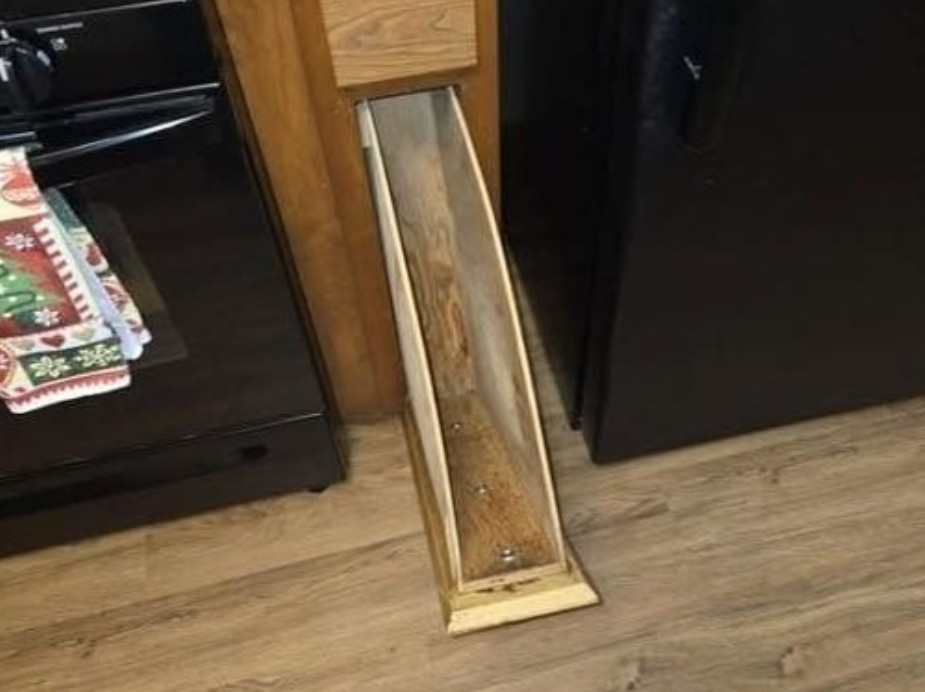
But the real answer is much simpler — and actually very clever. This is a pull-out holder for a cookbook or recipe book.
Before phones and tablets became part of everyday cooking, many people kept handwritten recipe books, family notebooks, or thick cookbooks in the kitchen. The problem was always the same: where do you put the book while cooking?
If it lay flat on the counter, it took up precious workspace. It could get covered in flour, oil, water, or sauce. If it was placed too far away, the cook had to keep walking over just to check the next step.
That is where this unusual little cabinet feature came in. The slanted wooden panel could be pulled out when needed, and the cookbook could rest against it. The small ledge at the bottom kept the book from sliding down.
Its position also makes sense. Being placed near the stove meant the recipe could be read while cooking, without taking over the counter or getting directly in the way. It was basically an old-school kitchen convenience, designed long before modern recipe apps existed.
What makes it confusing today is that most people no longer expect furniture to have such specific built-in functions. A narrow pull-out panel in a kitchen now looks mysterious, especially when it does not resemble a drawer, shelf, or cutting board.
But in homes where cooking was done from printed recipes, this was a genuinely useful detail. It kept the page visible, the book upright, and the counter free. For someone who cooked often, it probably felt like a small luxury.
So no, it was not a broken drawer or a strange pet station. It was most likely a built-in cookbook stand — a practical little feature made for anyone who followed recipes the traditional way.
In a modern kitchen, it could still be useful. You could place a cookbook there, a printed recipe, a tablet, or even a notebook. What looked like a mystery door was really a thoughtful piece of kitchen design from a time when recipes lived on paper.