

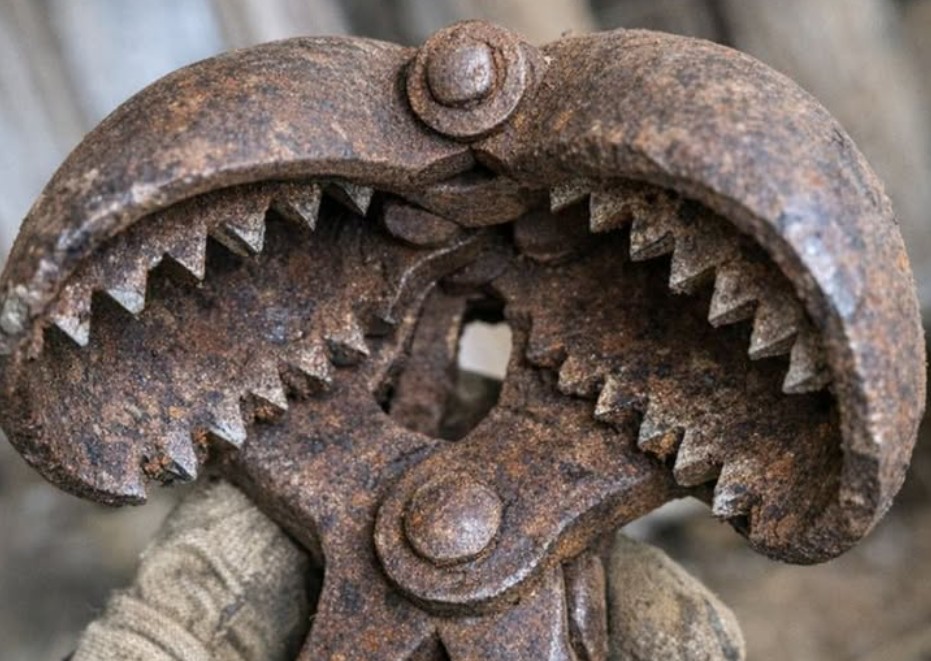
The tool is made entirely of iron, indicating it was built for durability and repeated use. It measures about 12 inches long and features a hinge at the center, allowing it to open and close like pliers. Along the inside curve of each arm are jagged teeth, approximately a quarter inch long, clearly designed to grip or strip material from an object.
Weighing roughly three pounds, the tool was intended for handheld use and required a fair amount of strength to operate. The heavy-duty hinge suggests it was built to withstand constant repetitive motion. All of these details point to a specialized agricultural tool.
Why the Jagged Teeth Matter
The jagged inner teeth provide an important clue about the tool’s function. Rather than cutting, the teeth were designed to grip and strip material away from a surface. Their spacing and shape suggest a repetitive shelling or stripping action.
This design works especially well for removing kernels from dried corn cobs. The teeth grip the kernels firmly and pull them free while leaving the cob intact.
How Antique Handheld Corn Shellers Worked
Before modern machinery, removing kernels from corn cobs was a slow and labor-intensive task. Handheld corn shellers offered farmers a simple but effective solution.
To use the tool, a dried corn cob was placed between the hinged arms. As the handles were squeezed together, the jagged teeth stripped the kernels from the cob. By rotating the cob and repeating the motion, users could quickly remove nearly all the kernels with minimal waste.
This process was much faster and easier than removing kernels by hand.