

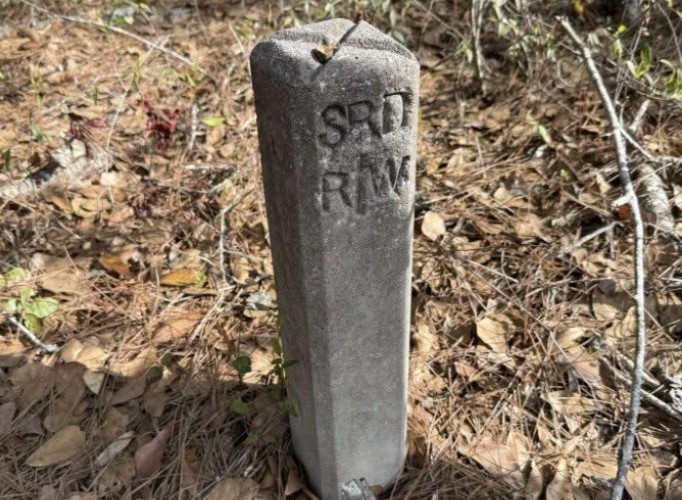
The letters carved into it offer the first clue: SRD and R/W. To most people, they may look like old survey markings or forgotten initials. But to anyone familiar with old infrastructure, land boundaries, or public works, those letters tell a much bigger story.
This is most likely a State Road Department right-of-way marker. “SRD” refers to the State Road Department, and “R/W” means right of way. In simple terms, this concrete post marked the official boundary of a road corridor. It showed where the government-controlled road property began or ended.
That may sound ordinary, but it changes the way you look at the entire area. The marker suggests that the old roadbed nearby was not just a random path through the woods. At one time, it was likely surveyed, recorded, built, and maintained as part of an official route.
Roads disappear faster than people think. Traffic patterns change, new highways are built, maintenance stops, and nature slowly takes over. Pavement cracks, gravel sinks into the soil, signs are removed, and trees grow where vehicles once passed. Within a few decades, a road can become little more than a shallow depression in the forest floor.
But markers like this often remain.
That is why these small posts are valuable. They can outlast the road itself. They may remain long after the pavement, signs, bridges, and even local memory have faded. A person walking through the woods today may see only trees and brush, while the concrete marker quietly preserves the outline of a forgotten transportation route.
Finding one can also help you notice other clues nearby. There may be a raised roadbed, old drainage ditches, gravel mixed into the soil, unusual straight lines in the landscape, or additional markers placed along curves and boundaries. Once you recognize what the post is, the woods stop looking completely natural and begin to reveal their history.
What makes this kind of discovery special is its simplicity. It is not a grand monument or a famous historic site. It is just a small concrete marker, placed for practical reasons, probably by workers who never imagined anyone would study it years later.
And yet, it still tells a story.
That knee-high post in the woods is more than an abandoned piece of cement. It is evidence of an old road, a forgotten route, and the people who once used it. Long after the road vanished beneath leaves and roots, the marker stayed behind — standing quietly, waiting for someone to notice it.