

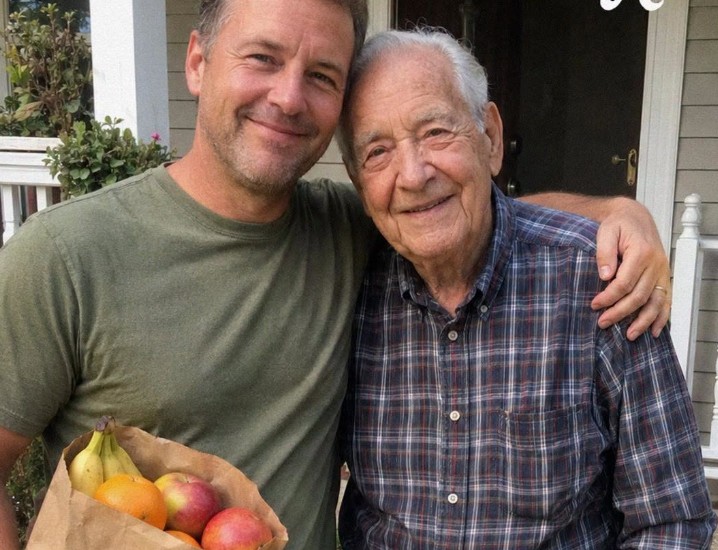
Ezra tried to refuse at first, but Anthony insisted. He carried the groceries into the kitchen, where the air smelled of old wood and coffee. Ezra moved slowly and carefully, the way people do when they have grown used to relying only on themselves.
As a thank-you, Ezra offered him a cup of coffee. Anthony almost declined, but something in the old man’s voice made him stay. They ended up talking for nearly an hour. Ezra spoke about the neighborhood as he remembered it back in the 1970s, about his late wife Margaret, and about a life that once felt very different.
When Anthony walked home that day, he thought he had simply done a good deed. He did not yet know that this chance encounter would become the beginning of a Sunday tradition that would last for 12 years.
Over time, Ezra’s health began to decline. At first, he only walked more slowly to the mailbox. Then driving became difficult. Anthony started buying groceries for him every Sunday. There was no formal agreement — it simply became part of their lives.
Ezra tried to pay him for his help, but Anthony always refused.
“I’m going to the store anyway. It’s no trouble,” he would say.
Gradually, those short visits became something more. They drank coffee together, talked about the past, about Anthony’s job, and later about his upcoming wedding to Claire. Sometimes they simply sat in silence, watching birds gather near the feeder. Even that silence felt meaningful.
When Anthony got married, Claire quickly understood how important those Sundays had become. She never objected. In fact, she sometimes sent homemade cookies for Ezra. The old man accepted those small gifts with such gratitude that they seemed priceless to him.
One day, Ezra mentioned his nephew, Marcus. According to him, Marcus only called when he needed something — money, help, or another favor. Ezra never openly complained, but each time he spoke about him, a quiet sadness appeared in his eyes.
Then came the Sunday that changed everything.
Anthony noticed that Ezra’s porch light was still on at nine in the morning. That was unusual. Ezra always turned it off at sunrise. At first, Anthony tried to convince himself that the old man had simply forgotten. But the uneasy feeling did not go away.
A few hours later, an ambulance stopped in front of Ezra’s house. He had passed away in his sleep — quietly, peacefully, in his own home.
There were only a few people at the funeral. Anthony stood among them, thinking that Ezra deserved a larger room, more flowers, and more words of remembrance. Among those present was a man in an expensive suit — Marcus, the nephew Ezra had spoken about.
His behavior was cold. He looked at his phone more often than at the coffin. After the ceremony, Marcus approached Anthony and referred to him as “the grocery guy.” There was no gratitude in his voice, no grief.
“The house needs to be sold quickly,” Marcus said. “No point letting it sit there.”
Anthony did not respond. He did not want to cause a scene at the funeral of a man he had truly considered a friend.
As Anthony was about to leave, Ezra’s lawyer, Mr. Whitman, approached him. In his hands was an old, worn suitcase.
“Mr. Harrison left very clear instructions that this was to be given to you,” the lawyer said. “Personally, and without anyone else involved.”
Anthony was confused. The suitcase was heavier than it looked. At that moment, Marcus walked over and sharply demanded to know what it was. The lawyer calmly explained that the suitcase was not part of the inheritance. It had been separately assigned to Anthony according to Ezra’s notarized instructions.
Marcus became furious. He accused Anthony of manipulating his uncle and insisted that everything Ezra owned should belong to the family. But the lawyer remained firm.
At home, Anthony hesitated for a long time before opening the suitcase. Claire stood beside him.
“Open it,” she said quietly.
Inside, there was no gold and no large amount of cash. Instead, there were old photo albums, a thick stack of letters, and a worn leather journal.
The first letter was dated the very same day Anthony had first helped Ezra with his groceries. Then there was a second. A third. Dozens, then hundreds of letters — one for nearly every Sunday. Ezra had written them for years but had never given them to him.
In the journal, Anthony learned something Ezra had rarely spoken about. Years earlier, Ezra and Margaret had lost their son, Daniel. Over time, Ezra had come to see Anthony not merely as a kind neighbor, but as someone who had brought the feeling of family back into his life.
A separate notarized document confirmed that Ezra had left Anthony a modest savings account that was not part of the main estate. It was not simply a gift. It was gratitude for years of presence, care, and humanity.
A few days later, Marcus came to Anthony’s house demanding answers. Anthony did not argue. He simply showed him one of the letters in which Ezra had written about his loneliness and the pain he felt from his relative’s indifference.
Marcus read the letter in silence. His anger slowly faded. He did not apologize, but he said nothing more. He simply left.
Afterward, Anthony used part of the money Ezra had left him to start a small initiative helping elderly people who lived alone. Every Sunday, volunteers brought them groceries and stayed for at least a short conversation.
Because with time, Anthony understood the most important thing: the suitcase had never really been about money. It was about memory. About friendship. About quiet acts of kindness that may seem small, but can become someone’s entire world.
Sometimes, all it takes is simply showing up. Every Sunday. Without grand promises. Without expecting anything in return.
That was what Ezra remembered until his final day.