

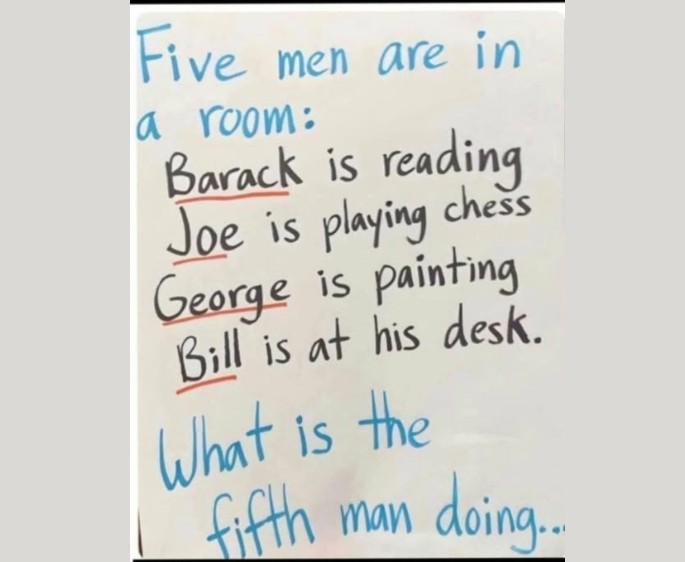
The prompt gives us four pieces of information:
Barack is reading.
Joe is playing chess.
George is painting.
Bill is at his desk.
Then comes the question:
What is the fifth man doing?
At first, many people begin searching for a hidden pattern. They look at the names. They think about presidents. They wonder whether “Bill is at his desk” is a clue. Some try to connect the activities to politics, history, or wordplay.
But the answer is much simpler.
The Answer
The fifth man is playing chess with Joe.
The clue is in the second line: Joe is playing chess.
Traditionally, chess is a game played by two people. Since the riddle tells us there are five men in the room, and only four are named, the unnamed fifth man is the most logical person to be Joe’s opponent.
Why So Many People Miss It
This riddle works because it takes advantage of how our brains process lists. When we read:
Barack is reading.
George is painting.
Bill is at his desk.
we see each man as doing an individual activity. That pattern makes us assume Joe must also be doing something alone. As a result, we stop thinking of chess as a two-person game and treat it as just another isolated action.
The phrase “Bill is at his desk” also acts as a distraction. It creates a strong mental image of work, paperwork, or an office. That pulls attention away from the most important clue: Joe’s chess game needs another player.
The Modern Twist
Some people argue that Joe could be playing chess online, against a computer, or even by himself. Technically, that is possible. But classic riddles usually rely on the simplest complete explanation.
The presence of an unnamed fifth man in the room is not random. It exists to complete the missing part of the scene. If Joe is playing chess and there is one man unaccounted for, the cleanest answer is that the fifth man is playing chess with him.
Why the Riddle Still Works
The “Fifth Man” riddle is effective because it exposes a common thinking habit: we often search for a complicated answer while ignoring the obvious one. The puzzle feels difficult not because the solution is hidden, but because it is too direct.
In the end, the riddle is less about chess and more about perception. Sometimes the answer is not buried in a secret clue. Sometimes it is sitting in plain sight, waiting for us to stop overthinking.